
- L’AFES est la branche française de l'Union Internationale de Science du Sol (IUSS, International Union of Soil Science)



Changing gardeners’ point of view on soils with a citizen science project in Southern‑East France
- 18/04/2025
- Rapports, Synthèses, Certificats
- Texte brut ou illustré
Soil and the threats it faces nowadays are often underestimated by citizens. This is rather due to a lack of awareness than to a lack of interest. In France, the surface covered by private gardens is not negligible, as it represents 2% of the territory, which is four times larger than the area of natural reserves in the country. Therefore, ensuring the protection and preserva-tion of healthy soils in these areas is of great importance. Citizen science is a good way to raise awareness about scientific issues. Using a scientific and educational approach, the citizen science project “La...

Participatory soil citizen science: An unexploited resource for European soil research
- 14/03/2024
- Ressource technique et scientifique
- Texte brut ou illustré
Abstract
Soils are key components of our ecosystems and provide 95%–99% of our food. This importance is reflected by an increase in participatory citizen science projects on soils. Citizen science is a participatory research method that actively involves and engages the public in scientific enquiry to generate new knowledge or understanding. Here, we review past and current citizen science projects on agricultural soils across Europe. We conducted a web-based survey and described 24 reviewed European citizen science projects in the light of the 10 principles of...

Participatory Research in Ecology for Agroecological Transitions: A Case Study in Viticulture
- 03/02/2026
- Rapports, Synthèses, Certificats
- Texte brut ou illustré
Participatory ecological research in agricultural contexts is on the rise. Developing
collaboration between farmers and ecology researchers is expected to both foster the acquisition
of fundamental knowledge, and guide farmers towards the adoption of ecological practices
through the co-construction of relevant expertise. Yet the impacts of these participatory
approaches on farmers’ practices are still poorly characterized. In this paper, we tackle this
issue by considering as a case study a participatory research project in viticulture (EcoVitiSol®)
Navigating the participatory turn in agricultural and food research: Best practice from citizen science
- 21/02/2025
- Ressource technique et scientifique
- Texte brut ou illustré
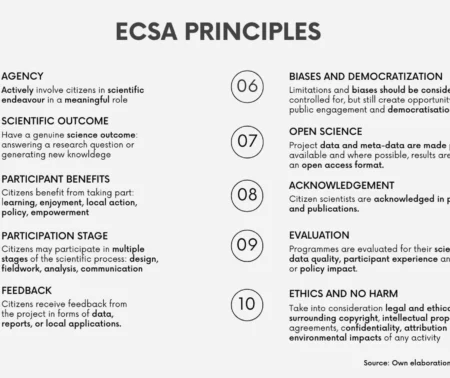
Cet article issu du groupe de travail AgriFood de l’ECSA propose un cadre pour guider les recherches participatives en agriculture et systèmes alimentaires, en s’appuyant sur les 10 principes des Citizen Sciences définis par l’ECSA. L’objectif : rendre ces principes plus accessibles, adaptés et opérationnels dans un champ confronté à des enjeux éthiques, sociaux et politiques majeurs.
Transdisciplinary participatory-action-research from questions to actionable knowledge for sustainable viticulture development
- Ressource technique et scientifique
- Texte brut ou illustré
Viticulture negatively impacts the environment, biodiversity, and human health; however, despite the widely acknowledged challenges that this intensive agricultural activity poses to sustainable development, measures to reduce its invasiveness are constantly being deferred or rebuffed. Constraints to change are linked to vine cultivation methods, the impacts of climate change on vine resilience and disease sensitivity, and socio-economic models, as well as growing criticisms from society. Research and training have thus far failed to provide solutions or mobilise stakeholders on a large...